
Indoor & Built-In Pizza Ovens: What to Know Before You Install One
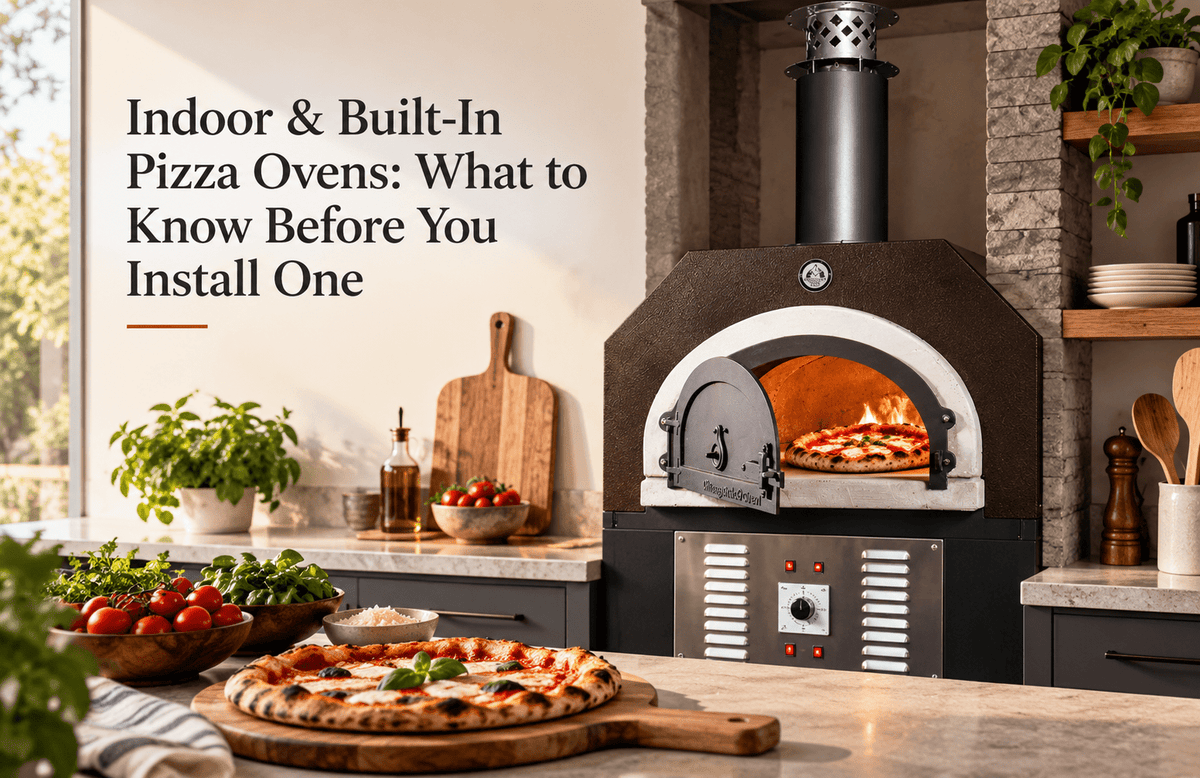
An indoor pizza oven can become the centerpiece of a kitchen, entertaining space, or commercial cooking environment. But choosing an oven for an indoor installation requires more than finding a model that fits the available space.
With Chicago Brick Oven, indoor suitability depends on the specific oven model and its certification. CBO offers wood-fired models certified for residential and commercial indoor or outdoor use, while its residential hybrid ovens are designed for outdoor use and its commercial hybrid ovens are certified for commercial indoor or outdoor applications.
This guide explains how to choose an indoor or built-in Chicago Brick Oven, what to consider when planning the installation, and how different CBO oven models compare.
Can You Install a Pizza Oven Indoors?
Yes, Chicago Brick Oven offers pizza ovens that are certified for indoor use, but the certification is specific to each model.
CBO has several wood-fired models including the CBO 500 Countertop, CBO 750 Countertop, CBO 500 DIY Kit, CBO 750 DIY Kit, and CBO 1000 DIY Kit as certified for residential and commercial indoor or outdoor use.
The hybrid lineup is different. The CBO 750 Hybrid Countertop Residential is certified for residential outdoor use only.
Shop Now
while the CBO 750 Hybrid Countertop Commercial is certified for commercial indoor or outdoor applications.
Shop Now
So, the first step in planning an indoor installation is simple:
“Choose the exact CBO model and verify its certification before designing the installation around it.”
What Is an Indoor or Built-In Pizza Oven?
An indoor pizza oven is installed inside an enclosed residential or commercial space rather than in an open outdoor kitchen or patio.
A built-in pizza oven refers to how the oven is incorporated into its surroundings. It may be integrated into a custom masonry structure, cabinetry system, or another purpose-designed enclosure.
The terms are related, but they do not mean exactly the same thing. An oven can be designed for indoor use without every possible enclosure or installation method automatically being suitable.
The oven's:
- Certification
- Dimensions
- Required clearances
- Chimney or venting arrangement
- Support structure
- Surrounding materials
- Installation environment
all need to be considered when planning the project.
Can You Install a Wood-Fired Pizza Oven Indoors?
Yes. CBO has several wood-fired ovens which are certified for residential and commercial indoor or outdoor use. These include the CBO 500 Countertop, CBO 750 Countertop, CBO 500 DIY Kit, CBO 750 DIY Kit, and CBO 1000 DIY Kit.
Wood-fired ovens produce combustion products, so an indoor installation needs to be planned around the appropriate chimney, flue, or other required venting system for the specific oven and installation.
For example, the CBO 500 and CBO 750 Countertop models are supplied with a Class A double-wall chimney, while the DIY kits provide the oven and installation components for a custom-built enclosure.
Before construction begins, confirm:
- The exact CBO oven model
- The model's current certification
- Required clearances
- Chimney or flue requirements
- Enclosure and surrounding-material requirements
- Applicable local building and fire requirements
- Any required permits or inspections
Do not assume that an existing fireplace chimney, kitchen exhaust system, or other venting system is automatically suitable for a CBO oven.
Which Chicago Brick Oven Models Are Certified for Indoor Use?
CBO wood-fired models that are currently listed for residential and commercial indoor or outdoor use.
CBO 500 Countertop

Shop Now
The CBO 500 Countertop is a wood-fired oven with a 27" x 22" cooking surface.
It is a small-footprint countertop oven and is certified for residential and commercial indoor or outdoor use.
The preassembled oven is fully insulated and includes a Class A double-wall chimney.
CBO 750 Countertop

Shop Now
The CBO 750 Countertop provides a larger 38" x 28" cooking surface and is also listed as certified for residential and commercial indoor or outdoor use.
It is a preassembled wood-fired oven designed to be placed on a sturdy base of your choice and includes a Class A double-wall chimney.
CBO 500 DIY Kit

Shop Now
The CBO 500 DIY Kit provides a 27" x 22" cooking surface and is designed for custom installations. CBO lists it as certified for residential and commercial indoor or outdoor use.
The kit includes the oven components, insulation and installation materials, along with accessories such as a pizza peel, cleaning brush, and infrared thermometer.
CBO 750 DIY Kit

Shop Now
The CBO 750 DIY Kit has a 38" x 28" cooking surface and is designed for custom-built installations. The kit can be incorporated into an indoor or outdoor oven design and is certified for residential and commercial indoor or outdoor use.
CBO 1000 DIY Kit

Shop Now
The CBO 1000 DIY Kit is the largest of these models, with a 53" x 39" cooking surface and more than 2,000 square inches of cooking space.
CBO 1000 DIY Kit is certified for residential and commercial indoor or outdoor use.
Because of its size and cooking capacity, it is particularly suited to projects that require a larger cooking area.
What About CBO Hybrid Pizza Ovens?
CBO's hybrid ovens combine gas and wood-fired cooking, but the residential and commercial versions have different certifications.
CBO 750 Hybrid Countertop Residential
The CBO 750 Hybrid Countertop Residential combines a two-burner gas system with wood-fired cooking.
However, CBO residential hybrid ovens are for outdoor use only. The model is certified for residential outdoor applications.
CBO 750 Hybrid Countertop Commercial
The CBO 750 Hybrid Countertop Commercial also combines gas and wood-fired cooking, with a two-burner gas system.
Unlike the Residential model, the Commercial Hybrid is certified for commercial indoor or outdoor use.
The Commercial Hybrid is available in Natural Gas (NG) or Propane Gas (LP), and the gas type must be designated when ordering because the unit cannot be retrofitted in the field.
The Key Difference
|
Model |
Fuel |
Current Listed Use |
|
CBO 500 Countertop |
Wood |
Residential & Commercial Indoor/Outdoor |
|
CBO 750 Countertop |
Wood |
Residential & Commercial Indoor/Outdoor |
|
CBO 500 DIY Kit |
Wood |
Residential & Commercial Indoor/Outdoor |
|
CBO 750 DIY Kit |
Wood |
Residential & Commercial Indoor/Outdoor |
|
CBO 1000 DIY Kit |
Wood |
Residential & Commercial Indoor/Outdoor |
|
CBO 750 Hybrid Countertop Residential |
Wood + Gas |
Residential Outdoor Only |
|
CBO 750 Hybrid Countertop Commercial |
Wood + Gas |
Commercial Indoor/Outdoor |
Always confirm the current product certification and installation requirements before beginning a project.
Ventilation, Chimney and Clearance Requirements
Indoor pizza oven installation should be planned around the requirements of the specific oven rather than a generic ventilation setup.
Chimney and Flue Requirements
Wood-fired cooking produces combustion products that need to be properly managed.
CBO's countertop wood-fired models include chimney components as part of the oven configuration. The CBO 500 and CBO 750 Countertop models, for example, include a Class A double-wall chimney.
For DIY installations, the chimney or flue system should be selected and installed according to the applicable product documentation and local requirements.
Commercial Hybrid Ventilation
The CBO 750 Hybrid Countertop Commercial is certified for commercial indoor or outdoor use.
For an indoor commercial installation, the CBO Hybrid oven must use a commercial ventilation system meeting NFPA 96 or UL 710, along with applicable local building, fire and mechanical requirements.
Clearance From Combustible Materials
Clearance is another important consideration.
There is no single clearance figure that should automatically be applied to every CBO oven. Requirements depend on the specific model and installation.
Before finalizing cabinetry, masonry, walls, or other surrounding structures, confirm the exact clearance requirements for the oven you are installing.
What Should You Consider Before Building an Indoor Pizza Oven?
1. Choose the Oven Model First
Start with the exact oven model rather than designing the enclosure first.
A CBO 750 Countertop and CBO 750 Hybrid Countertop Residential may have similar size references, but they are different products with different certifications.
2. Confirm the Certification
Verify that the specific model is certified for your intended residential or commercial application.
This is particularly important when comparing CBO’s Residential and Commercial Hybrid models.
3. Determine the Cooking Surface You Need
Consider how much food you expect to cook at one time.
The CBO 500 provides a 27" x 22" cooking surface, while the CBO 750 provides 38" x 28". The CBO 1000 DIY Kit increases the cooking surface to 53" x 39".
4. Decide Between Countertop and DIY
A countertop oven arrives preassembled, while a DIY kit allows you to create a more customized enclosure.
The CBO 750 DIY Kit, for example, can be incorporated into a custom indoor or outdoor design.
5. Plan the Chimney or Venting System
Determine the appropriate chimney, flue, or ventilation requirements before construction begins.
6. Check Clearances
Make sure the planned installation provides the required clearances around the oven and uses appropriate surrounding materials.
7. Check Local Requirements
Residential and commercial projects may have different building, fire, and mechanical requirements.
Check the applicable local requirements before beginning installation.
8. Involve a Qualified Professional When Needed
For complex installations involving structural modifications, chimney or flue routing, commercial ventilation, or major remodeling, involve the appropriate professional early in the planning process.
Indoor Pizza Oven Installation: A Simple Planning Process
A successful installation starts with planning in the right order.
Step 1: Select the Exact CBO Model
Identify the exact model you want to install.
Step 2: Verify Its Certification
Confirm that the model is certified for your intended indoor residential or commercial application.
Step 3: Review the Product Specifications
Check dimensions, cooking surface, chimney or venting components, clearances, and installation requirements.
Step 4: Design the Enclosure
Once the oven requirements are confirmed, design the surrounding masonry, cabinetry, countertop, or other structure around the oven.
Step 5: Plan Ventilation or Chimney Routing
Determine how combustion products will be safely managed according to the product requirements and applicable codes.
Step 6: Confirm Local Requirements
Check whether your project requires permits, inspections, or professional installation.
Step 7: Complete the Installation
Follow the product's installation instructions and applicable requirements before operating the oven.
Indoor Pizza Ovens: Pros and Cons
|
Advantages |
Considerations |
|
Creates a striking focal point |
Requires more installation planning than a simple outdoor placement |
|
Provides year-round access to pizza-oven cooking |
Chimney or ventilation requirements must be considered |
|
Can be incorporated into a custom kitchen design |
Existing-space retrofits can be more complicated |
|
Wood-fired models provide authentic wood-fired cooking |
Clearances need to be considered during enclosure design |
|
Commercial Hybrid models offer gas and wood-fired cooking |
Commercial installations require appropriate planning |
Expert Tip: Choose the Oven Before the Enclosure
One of the most important decisions when planning an indoor CBO installation is to select the oven before finalizing the surrounding structure.
A useful planning sequence is:
Oven Model → Certification → Specifications → Clearances → Chimney/Venting → Enclosure → Installation
This approach helps reduce the risk of designing a finished space around an oven that is not certified for the intended application.
It also prevents confusion between similarly named CBO products with different configurations and certifications.
Key Takeaways
- Indoor suitability is model-specific.
- The CBO 500 Countertop and CBO 750 Countertop are currently listed for residential and commercial indoor or outdoor use.
- The CBO 500, CBO 750, and CBO 1000 DIY Kits are also listed for residential and commercial indoor or outdoor use.
- The CBO 750 Hybrid Countertop Residential is certified for residential outdoor use only.
- The CBO 750 Hybrid Countertop Commercial is certified for commercial indoor or outdoor use.
- Indoor installations require proper planning for clearances, chimney/flue or ventilation requirements, surrounding materials, and applicable local codes.
- Do not assume that every CBO oven or every CBO 750 model has the same certification.
- Choose the exact oven model and confirm its certification before designing the surrounding structure.
Conclusion
An indoor pizza oven can be a major feature in a residential kitchen or commercial cooking space, but the installation should start with the specific oven model and its certification.
Chicago Brick Oven offers wood-fired countertop ovens, DIY kits, and hybrid models, but their intended applications differ. Several CBO wood-fired models are currently certified for indoor and outdoor use, while the Residential Hybrid is designed for outdoor residential applications and the Commercial Hybrid is certified for commercial indoor or outdoor use.
The best approach is straightforward: select the exact model, verify its certification, review the installation requirements, plan the appropriate chimney or ventilation system, and then design the surrounding space.
With the right planning, a Chicago Brick Oven can become a functional and visually striking centerpiece for your kitchen or commercial space.
Frequently Asked Questions
Can I install a Chicago Brick Oven indoors?
Yes. CBO currently lists several wood-fired models for residential and commercial indoor or outdoor use, including the CBO 500 Countertop, CBO 750 Countertop, CBO 500 DIY Kit, CBO 750 DIY Kit, and CBO 1000 DIY Kit.
Can I install the CBO 750 Hybrid Countertop Residential indoors?
No. CBO identifies the Residential Hybrid as certified for residential outdoor use only.
Can the CBO 750 Hybrid Countertop Commercial be installed indoors?
Yes. CBO identifies the Commercial Hybrid as certified for commercial indoor or outdoor applications.
Are CBO DIY kits suitable for indoor installations?
Several CBO DIY kits are currently listed as certified for residential and commercial indoor or outdoor use, including the CBO 500, CBO 750, and CBO 1000 DIY Kits.
Do all CBO 750 ovens have the same certification?
No. The CBO 750 Countertop, CBO 750 DIY Kit, CBO 750 Hybrid Countertop Residential, and CBO 750 Hybrid Countertop Commercial are different products.
Their fuel systems, configurations, and certifications are not identical.
Can I use a standard kitchen range hood for an indoor CBO oven?
Do not assume that a standard residential range hood is sufficient.
The appropriate chimney, flue, ventilation, and installation requirements depend on the exact oven model and installation environment.
For commercial indoor installations, the ventilation system should be planned according to the requirements of the certified commercial installation.
How much clearance does an indoor CBO oven need?
Clearance requirements depend on the specific CBO model and installation.
Always review the current product specifications and installation documentation before finalizing an enclosure.
Can I retrofit a CBO oven into an existing kitchen?
Potentially yes, but a retrofit may require more planning than a new installation.
Before committing to an oven, evaluate the available space, required clearances, chimney or ventilation route, support structure, surrounding materials, and local requirements.
Leave a comment