
Propane Pizza Ovens for Food Trucks: What Commercial Operators Need to Know
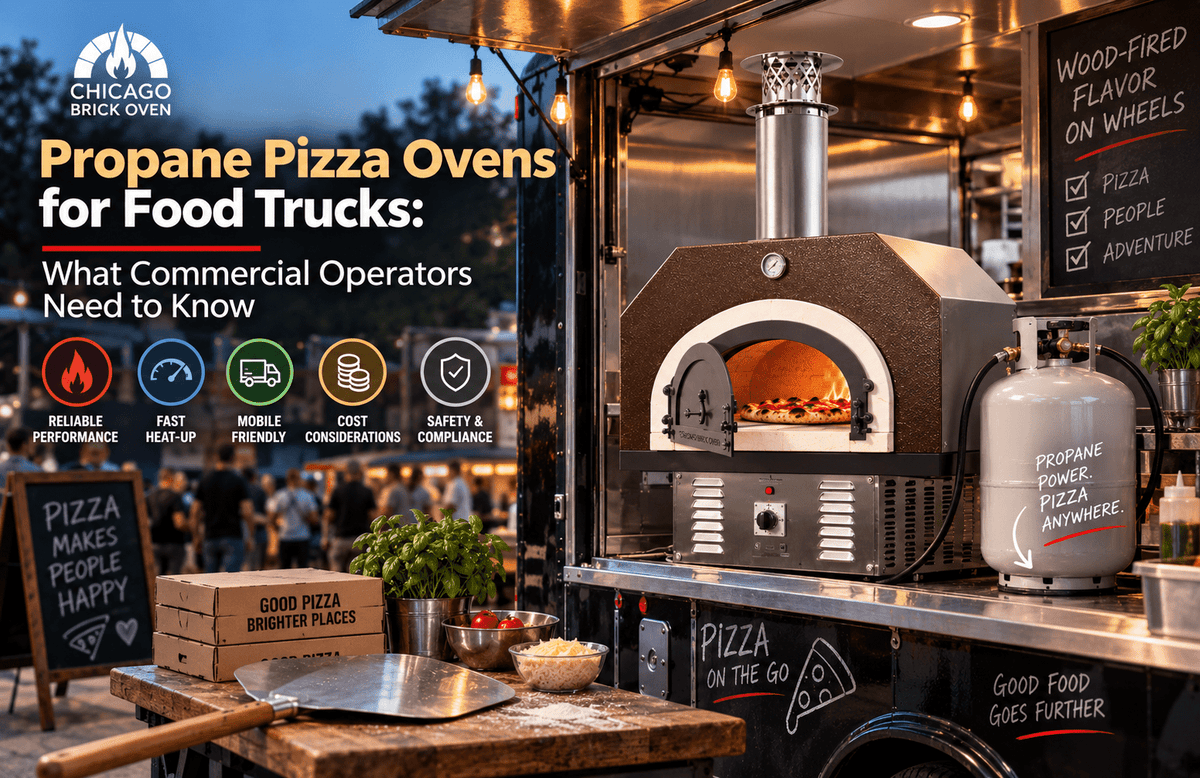
For a food truck, the pizza oven is one of the most important pieces of cooking equipment you will install. It needs to deliver high heat, recover quickly between pizzas, fit within the vehicle's available space and weight capacity, and meet the applicable safety and commercial requirements.
A propane pizza oven commercial setup can be attractive because propane provides convenient, controllable heat without requiring the operator to carry large quantities of firewood. However, choosing an oven for a mobile business requires more than looking at BTUs or cooking temperature.
Food truck operators should evaluate the oven's commercial certification, fuel configuration, heat output, physical dimensions, installation requirements, ventilation, vehicle load capacity, and local fire and health regulations before purchasing or installing a pizza oven.
For operators who want gas convenience without giving up wood-fired cooking, Chicago Brick Oven's commercial hybrid systems offer another option: gas and real hardwood in the same high-performance cooking system.
What Should You Look for in a Food Truck Pizza Oven?
The right food truck pizza oven should match your menu, expected order volume, available space, fuel infrastructure, and local requirements.
Before selecting an oven, evaluate these key factors:
- Commercial certification
- Propane or natural gas configuration
- Burner output and heat recovery
- Cooking surface size
- Oven dimensions and weight
- Ventilation and flue requirements
- Available vehicle capacity
- Installation requirements
- Local fire and health department approvals
- Daily production requirements
A food truck is a constrained cooking environment. An oven that performs well in a restaurant or outdoor kitchen is not automatically appropriate for a mobile installation.
That distinction is important when evaluating mobile pizza oven options.
Propane vs. Wood: What Makes Sense for a Food Truck?
Propane offers operational convenience. There is no need to store large quantities of firewood inside or around the truck, and gas heat can be controlled without maintaining a traditional wood fire.
For some operators, that makes propane a practical choice for high-volume service.
But wood offers something gas alone cannot reproduce: the aroma, visible flame, and flavor associated with live-fire cooking.
This is why Chicago Brick Oven developed hybrid cooking systems that combine gas and wood. The commercial CBO-750 Hybrid Countertop oven, for example, is available in propane (LP) or natural gas (NG) and combines a two-burner gas system with a dedicated area for burning wood. The commercial model has a 38" × 28" cooking surface.
For a mobile pizza business where the menu and brand experience are built around wood-fired pizza, that flexibility can be valuable.
Why BTUs Matter But Aren't Everything
Burner output matters because a commercial operator needs an oven that can reach and maintain its operating temperature during service.
However, BTUs alone do not tell you how an oven will perform.
Heat retention, refractory construction, insulation, cooking-floor design, airflow, and flame circulation all influence performance.
The CBO-750 Hybrid Commercial uses two propane burners: a 35,000 BTU ambient burner and a 34,500 BTU infrared burner beneath the hearth, for a combined propane burner rating of 69,500 BTU.
The infrared hearth burner provides heat directly beneath the cooking floor, while the ambient burner is positioned toward the rear of the hearth. This two-burner arrangement is designed to create different types of heat within the cooking chamber.
That matters during commercial service because the cooking floor needs to remain hot while pizzas are being launched, rotated, and removed continuously.
Heat Retention Matters During a Rush
A pizza oven can reach a high peak temperature and still perform poorly during a busy service if it cannot retain and recover heat effectively.
Chicago Brick Oven addresses this through its proprietary commercial-grade refractory cement and low-dome design. CBO ovens are engineered to hold heat and can cook at temperatures exceeding 1,000°F.
The low dome also works with FlameRoll™ technology to circulate concentrated heat through the cooking chamber.
Rather than relying only on the burner output, the oven's refractory mass stores heat and releases it back into the cooking environment.
For a food truck operator, that distinction can be more meaningful than simply comparing the BTU rating of two ovens.
Consider the Cooking Surface and Menu
The correct oven size depends on how many pizzas you expect to produce and the type of menu you operate.
A larger hearth can provide more room for multiple pizzas and other dishes, but a larger oven also requires more available space and structural capacity.
The commercial CBO-750 Hybrid has a 38" × 28" cooking surface, providing substantial room for commercial pizza production and other high-temperature cooking.
And pizza does not have to be the only menu item.
A CBO commercial oven can be used for foods such as:
- Artisan breads
- Roasted vegetables
- Meat
- Fish
- Baked dishes
- Desserts
- Cast-iron recipes
That versatility can help a food truck create a broader menu around one central cooking system.
Weight and Vehicle Capacity Are Critical
One of the most important considerations for any mobile pizza oven is the vehicle itself.
A commercial brick oven is fundamentally different from a lightweight portable pizza oven. The oven, stand or base, hood, chimney, gas equipment, and associated installation components all contribute to the total load.
Before installation, operators should work with the vehicle builder or an appropriately qualified professional to verify:
- Vehicle payload capacity
- Floor and mounting structure
- Weight distribution
- Oven anchoring
- Equipment clearances
- Fuel-system placement
- Ventilation requirements
Never assume that an available floor area means the vehicle can safely support the equipment.
The oven should be treated as part of the truck's engineered cooking system.
Propane Tank Planning
Propane storage also needs careful planning.
Commercial operators should not simply install a standard consumer propane cylinder and assume it is suitable for a food truck. Tank size, mounting location, piping, regulators, shutoff equipment, protection from impact, and ventilation requirements can vary depending on the vehicle and jurisdiction.
Work with your food truck builder and the applicable fire authority to determine the appropriate propane system for your vehicle.
For CBO hybrid ovens, the gas configuration must be selected as LP or NG at the time of order; CBO states that the gas type cannot be retrofitted in the field on applicable hybrid models.
That makes fuel planning an early design decision rather than something to solve after the oven arrives.
Commercial Certification Matters
A food truck is a commercial food-service environment, so certification should be part of your buying decision.
The CBO-750 Hybrid Countertop Commercial is certified for commercial indoor and outdoor applications and conforms to ANSI Z83.11, is certified to CSA 1.8, and carries NSF certification for indoor/outdoor commercial applications, according to CBO's current product specifications.
This is an important distinction between a purpose-built commercial oven and a residential outdoor appliance.
However, an oven's certification does not automatically mean that every food truck installation will be approved. The vehicle installation itself may be subject to additional requirements from local fire, health, building, or other authorities.
Always confirm the complete installation with the relevant authorities and your food truck builder before purchasing.
Ventilation, Clearances and Fire Safety
Installing a pizza oven inside a mobile food unit requires careful attention to ventilation, clearances, combustion air, exhaust, and surrounding materials.
Your installation may need to account for:
- Hood and exhaust requirements
- Flue routing
- Combustible-material clearances
- Gas shutoff equipment
- Fire suppression requirements
- Propane storage
- Emergency access
- Vehicle-specific fire code requirements
Requirements vary by location, so operators should not rely on a generic online checklist as proof of compliance.
Your local authority having jurisdiction (AHJ), food truck builder, and qualified installation professionals should determine the final configuration.
Why Consider a Commercial CBO Hybrid Oven?
Chicago Brick Oven was founded in 2006 after its founders encountered the problems associated with imported brick ovens, including long shipping times, high import costs, shipping risks, and limited local support.
That experience shaped CBO's approach to commercial oven engineering.
The commercial CBO-750 Hybrid combines American manufacturing, commercial certification, high-temperature refractory construction, gas convenience, and real wood-fired cooking in one system.
Its dual-fuel design allows operators to use propane for convenient heat while adding hardwood to bring authentic wood-fired flavor to the menu.
The oven's proprietary refractory cement, low-dome geometry, and FlameRoll™ technology are designed to support high, even temperatures while retaining the character of live-fire cooking.
For a food truck built around artisan pizza, that combination can help create a distinctive cooking experience rather than simply providing another heat source.
Is a Propane Pizza Oven Right for Your Food Truck?
A propane oven can be an excellent choice for a mobile pizza business when convenience, controllability, and fuel logistics are priorities.
But commercial operators should evaluate the complete system—not just the burner.
Before purchasing a food truck pizza oven, confirm:
- The oven is appropriate for commercial use.
- Its certification matches your application.
- The fuel type is compatible with your planned system.
- The vehicle can safely support the oven's weight.
- The cooking surface matches your expected volume.
- Ventilation and exhaust requirements can be met.
- Propane storage complies with applicable requirements.
- Installation has been reviewed by qualified professionals.
- Local fire and health authorities approve the final configuration.
If authentic wood-fired flavor is central to your brand, a commercial hybrid oven can provide another path: propane convenience when you need it, with real hardwood available when you want the flavor and live-fire experience.
Frequently Asked Questions
Can a propane pizza oven be used in a food truck?
A propane pizza oven may be suitable for a food truck when the specific oven, fuel system, vehicle installation, ventilation, and safety requirements meet applicable commercial and local regulations. Operators should confirm the complete installation with their food truck builder and local authorities before purchase.
Does Chicago Brick Oven make a propane commercial pizza oven?
Yes. The CBO-750 Hybrid Countertop Commercial is available in propane (LP) or natural gas (NG). It uses two gas burners and also allows hardwood to be burned for wood-fired cooking.
How many BTUs does the CBO-750 Hybrid Commercial use with propane?
The CBO-750 Hybrid Commercial lists a 35,000 BTU ambient propane burner and a 34,500 BTU propane infrared hearth burner.
Can I use both propane and wood in a CBO hybrid oven?
Yes. The CBO-750 Hybrid Commercial is designed as a dual-fuel system. Gas provides convenient heat through its two-burner system, while hardwood can be burned at the back or side of the oven to introduce wood-fired flavor.
Is the CBO-750 Hybrid Commercial certified for commercial use?
Yes. CBO states that the commercial CBO-750 Hybrid is certified for indoor and outdoor commercial applications and conforms to ANSI Z83.11, CSA 1.8, and NSF requirements for those applications. Food truck operators should still confirm that their specific mobile installation meets all applicable local requirements.
Final Takeaway
Choosing a food truck pizza oven is ultimately an engineering and operational decision. The right system needs to deliver the cooking performance your menu demands while fitting the vehicle's structural, fuel, ventilation, and regulatory requirements.
For operators who want propane convenience without abandoning authentic wood-fired cooking, Chicago Brick Oven's commercial hybrid approach provides both options in one high-performance cooking system.
Gas gives you control. Wood gives you character. CBO gives commercial operators the ability to cook with both.
Leave a comment