
Pizza Oven Installation Requirements: Clearance, Height & Ventilation Rules
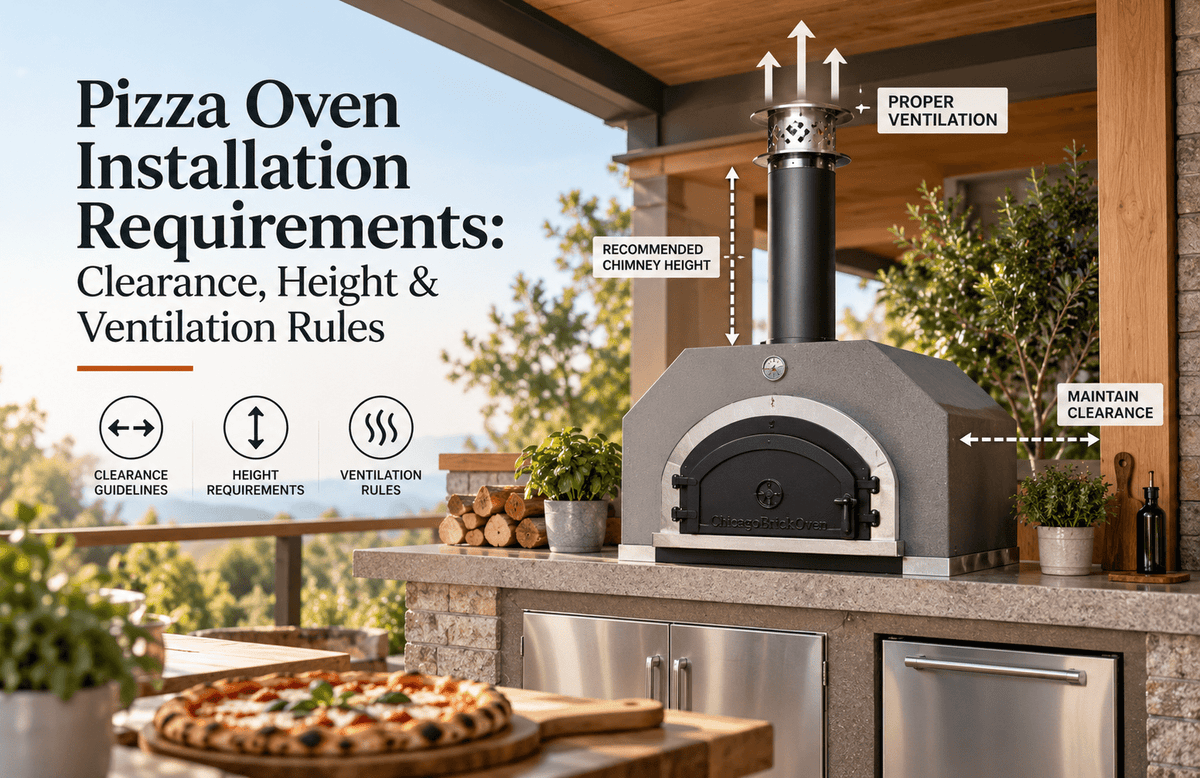
Installing a pizza oven is about more than finding a suitable location and building a countertop around it. The oven's height, clearance, chimney or ventilation system, surrounding materials, and certification all need to be considered before construction begins.
The most important rule is simple:
“Pizza oven installation requirements are model-specific. Do not estimate clearances, ventilation, or installation dimensions based on another oven or a generic rule.”
Chicago Brick Oven offers different oven configurations, including wood-fired and hybrid models, and their installation requirements can vary depending on the specific model and whether the oven is being installed in a residential or commercial setting. For example, it identifies its Residential Hybrid as certified for outdoor residential use only, while its Commercial Hybrid is certified for commercial indoor or outdoor applications.
This guide explains the key installation considerations to review before building an indoor or outdoor pizza oven installation.
Quick Answer: What Do You Need to Install a Pizza Oven?
A proper pizza oven installation requires you to confirm several things before construction begins:
- The exact CBO oven model
- The oven's certification
- Required clearances from combustible materials
- Appropriate support or foundation
- Hearth and installation height
- Chimney, flue, or ventilation requirements
- Surrounding construction materials
- Local building and fire-code requirements
- Required permits or inspections
There is no single clearance, height, or ventilation specification that applies to every CBO pizza oven.
The exact requirements should be confirmed from the documentation for the specific oven you are installing before your contractor finalizes the foundation, cabinetry, enclosure, chimney, or ventilation system.
Why Pizza Oven Installation Requirements Matter
A pizza oven operates at very high temperatures. CBO ovens can cook at temperatures exceeding 1,000°F, so the surrounding structure needs to be planned accordingly.
Installation requirements are designed to address issues such as:
- Heat exposure
- Combustible materials
- Combustion byproducts
- Structural support
- Safe access to the cooking surface
- Proper exhaust
- Local code compliance
Getting these details right before construction begins is much easier than modifying a completed outdoor kitchen or indoor installation later.
What Is the Correct Height for a Pizza Oven?
There is no universal installation height that should be applied to every CBO oven.
The appropriate height depends on the specific oven, its installation configuration, the surrounding structure, and applicable requirements.
For many outdoor kitchen designs, the oven hearth may be positioned around countertop height for comfortable access. However, a general countertop height should not be treated as a certified minimum or mandatory installation dimension.
Before your contractor builds the base, stand, cabinetry, or enclosure:
- Identify the exact CBO model.
- Review the model's installation documentation.
- Confirm the required installation elevation.
- Confirm required clearances.
- Design the surrounding structure around those specifications.
This approach is more reliable than starting with a generic 36–42-inch height range.
What Is Clearance to Combustibles?
Clearance to combustibles is the required distance between the oven or its heat-producing components and materials that can burn.
These materials may include:
- Wood framing
- Wood cabinetry
- Decking
- Certain wall materials
- Decorative materials
- Other combustible construction
The exact clearance requirements depend on the oven model and installation configuration.
Why Clearance Matters
A pizza oven produces sustained high heat. Materials that are too close to the oven can be exposed to temperatures they were not designed to withstand.
For that reason, don't simply measure the clearance from another pizza oven installation and copy it.
Use the requirements for the exact CBO model being installed.
How Should You Plan the Oven Foundation or Support?
A pizza oven needs a properly designed support structure capable of carrying the oven and its surrounding construction.
Depending on the model, this may involve:
- A masonry base
- A metal support
- A CBO stand
- A purpose-built outdoor kitchen cabinet
- A custom structure designed around a CBO DIY kit
The support structure should be designed around the actual oven dimensions and weight rather than being selected after the enclosure has already been built.
For a custom DIY installation, the foundation and surrounding structure should also account for the oven's insulation, hearth, chimney/flue components, and applicable clearances.
Ventilation and Chimney Requirements by Oven Type
This is one of the most important areas to get right.
Ventilation requirements are determined by the oven's certification and installation setting.
They should not be generalized as "wood-fired = chimney" and "hybrid = range hood."
The correct approach is to identify the specific model and follow its certified installation requirements.
Wood-Fired Pizza Ovens
Wood-fired ovens produce combustion byproducts that need to be safely exhausted.
For an indoor wood-fired installation, the appropriate chimney or flue system must be designed to safely route combustion products to the exterior.
CBO's 750 DIY wood-fired oven identifies the model as having Commercial & Residential certification.
For any indoor installation, however, the exact chimney/flue arrangement must be confirmed for the specific oven and installation.
Important
Do not assume that:
- An existing fireplace chimney is automatically suitable.
- A standard kitchen range hood can replace the required chimney/flue.
- A chimney designed for another appliance is appropriate for a CBO oven.
The installation needs to follow the applicable product requirements and local codes.
Hybrid Pizza Ovens
Hybrid ovens combine wood and gas capability, but hybrid does not automatically mean indoor installation.
This distinction is critical.
Residential Hybrid
CBO 750 Hybrid Residential is certified for outdoor residential use only.
Therefore, it should not be presented as an indoor residential pizza oven simply because it uses gas.
Commercial Hybrid
CBO 750 Hybrid Commercial as certified for commercial indoor or outdoor use.
For an indoor commercial installation, the CBO Hybrid oven must use a commercial ventilation system meeting NFPA 96 or UL 710, along with applicable local building, fire and mechanical requirements.
The Key Rule
The certification of the specific oven determines whether the oven can be installed indoors, not simply the fact that it uses gas or is a hybrid model.
Indoor vs. Outdoor Pizza Oven Installation
The installation environment can significantly affect the planning process.
|
Installation |
Main Considerations |
|
Outdoor patio |
Clearances, support, weather exposure, chimney/flue requirements |
|
Outdoor kitchen |
Cabinetry, countertop height, clearances, chimney/flue routing |
|
Residential indoor |
Model certification, approved exhaust/chimney system, clearances, building/fire requirements |
|
Commercial indoor |
Commercial certification, required ventilation, clearances, permits and inspections |
|
Custom DIY installation |
Oven specifications, foundation, insulation, enclosure, chimney/flue, local code |
The important point is that an oven suitable for one setting may not be suitable for another.
For example, CBO's Residential Hybrid is certified for outdoor residential use, while the Commercial Hybrid is certified for commercial indoor or outdoor use.
Installation Requirements for a CBO DIY Pizza Oven
DIY does not mean that installation requirements disappear.
A CBO DIY kit gives the homeowner or contractor greater flexibility to build the surrounding structure, but the installation still needs to follow the applicable product requirements.
The CBO 750 DIY wood-fired kit is currently listed as Commercial & Residential certified.
A DIY installation should therefore account for:
- Proper foundation
- Oven support
- Insulation
- Clearances
- Enclosure materials
- Chimney/flue requirements
- Hearth elevation
- Local building and fire codes
DIY vs. Professional Installation
A capable homeowner may handle portions of a DIY project, but installations involving indoor use, chimney/flue routing, structural modifications, gas connections, or commercial ventilation should involve the appropriate qualified professionals.
The goal is not simply to assemble the oven.
The goal is to create an installation that is safe, code-compliant, and appropriate for the specific CBO model.
How to Plan an Indoor Pizza Oven Installation
Indoor installation requires more planning than simply placing the oven inside an existing kitchen.
1. Select the Exact Oven
Start with the model—not the kitchen design.
2. Confirm Certification
Determine whether that exact model is certified for the intended residential or commercial indoor application.
3. Review the Installation Documentation
Check:
- Clearances
- Installation elevation
- Chimney/flue requirements
- Ventilation
- Support requirements
- Fuel requirements
4. Plan the Exhaust Route
Determine how combustion products or exhaust will be safely managed and routed according to the certified installation.
5. Design the Surrounding Structure
Only after the oven requirements are known should you finalize:
- Countertops
- Cabinets
- Masonry
- Walls
- Enclosures
- Support structures
6. Check Local Requirements
Confirm applicable building, fire, mechanical, and fuel requirements.
7. Complete Required Inspections
Where permits or inspections are required, schedule them before the oven is placed into service.
How to Plan an Outdoor Pizza Oven Installation
Outdoor installations are often more straightforward, but they still require planning.
Consider:
Location
Choose a location that provides appropriate clearance from structures, combustible materials, overhangs, and other potential hazards.
Foundation
Ensure the base can support the oven and surrounding construction.
Countertop or Stand Height
Position the cooking surface at an appropriate working height while following the exact requirements for your model.
Chimney or Flue
Plan the chimney or flue route before completing the surrounding kitchen structure.
Weather Protection
Consider how the oven will be protected when it is not being used.
A cover can help protect an outdoor oven from weather exposure during periods of non-use.
Common Pizza Oven Installation Mistakes to Avoid
1. Designing the Kitchen Before Selecting the Oven
This can create problems with dimensions, clearances, chimney placement, and support.
Better approach: Select the oven first and design around its specifications.
2. Assuming Every CBO Oven Has the Same Requirements
CBO offers multiple oven types and certifications.
Better approach: Check the documentation for the exact model.
3. Estimating Clearance
Clearance requirements should never be guessed.
Better approach: Confirm the required dimensions before construction.
4. Assuming Hybrid Means Indoor-Suitable
A hybrid residential model can still be outdoor-only.
Better approach: Verify the exact certification.
5. Treating a Range Hood as a Universal Pizza-Oven Vent
This is particularly important for indoor installations.
Better approach: Follow the certified ventilation or chimney/flue requirements for the exact model and installation setting.
6. Building the Chimney After the Kitchen Is Finished
Late chimney planning can create expensive structural changes.
Better approach: Plan the exhaust route before finalizing the enclosure.
7. Ignoring Local Codes
Product certification does not eliminate the need to comply with applicable local requirements.
Better approach: Confirm local building, fire, mechanical, and fuel requirements before construction.
Step-by-Step Pizza Oven Installation Planning Checklist
Use this checklist before starting construction.
Step 1: Select Your CBO Model
Identify the exact oven, fuel configuration, and intended application.
Step 2: Verify Certification
Confirm residential or commercial certification and whether indoor or outdoor installation is permitted.
Step 3: Review Clearances
Document all required clearances before designing the enclosure.
Step 4: Confirm Installation Elevation
Determine the required elevation and plan the foundation or stand accordingly.
Step 5: Plan the Exhaust System
Determine the required chimney, flue, or ventilation system for the specific oven.
Step 6: Select Appropriate Construction Materials
Make sure materials around the oven are appropriate for the heat exposure and required clearances.
Step 7: Check Utilities
For hybrid models, plan the appropriate gas connection according to the product requirements.
Step 8: Check Local Codes
Verify building, fire, mechanical, fuel, and permit requirements.
Step 9: Complete Construction
Build the support, enclosure, cabinetry, chimney/flue, and other components according to the approved plan.
Step 10: Inspect Before Use
Complete any required inspections and verify the installation before the first fire.
DIY or Professional Installation: Which Should You Choose?
The right approach depends on the complexity of your project.
DIY May Make Sense When:
- You are using a CBO DIY kit.
- The installation is straightforward.
- You are comfortable following detailed installation requirements.
- You have the appropriate construction skills.
- No complex structural or commercial ventilation work is involved.
Consider Professional Help When:
- Installing indoors
- Routing a chimney through a structure
- Connecting gas
- Modifying structural elements
- Building a complex masonry enclosure
- Installing in a commercial kitchen
- Dealing with local permitting or inspection requirements
When safety, structural work, gas, or commercial ventilation is involved, professional involvement can help ensure that the installation is completed correctly.
Key Takeaways
- Pizza oven installation requirements are model-specific.
- Confirm the exact CBO model before planning the foundation, cabinetry, enclosure, chimney, or ventilation.
- Do not estimate clearance-to-combustibles requirements.
- Do not assume one installation height applies to every CBO oven.
- Indoor suitability depends on the specific model's certification and installation setting.
- The CBO 750 Hybrid Residential is certified for outdoor residential use only.
- The CBO 750 Hybrid Commercial is certified for commercial indoor or outdoor applications.
- CBO's 750 DIY wood-fired kit is currently listed with Commercial & Residential certification.
- Wood-fired installations require appropriate management of combustion exhaust.
- Do not treat a standard range hood as a universal replacement for a pizza oven's required exhaust system.
- Check applicable local building, fire, mechanical, and fuel requirements before construction.
- When the project involves indoor installation, gas, structural modifications, chimney/flue routing, or commercial ventilation, involve the appropriate qualified professionals.
Conclusion
A successful pizza oven installation starts with the exact oven model, not with a generic set of dimensions.
Before construction begins, confirm the model's certification, installation elevation, clearance requirements, support requirements, and chimney, flue, or ventilation requirements. Then design the surrounding kitchen or enclosure around those specifications.
CBO's range includes different configurations with different intended applications. For example, the CBO 750 Hybrid Residential is certified for outdoor residential use only, while the CBO 750 Hybrid Commercial is certified for commercial indoor or outdoor applications.
The most important takeaway is that fuel type alone does not determine indoor suitability. A hybrid oven is not automatically an indoor oven, and a generic range-hood approach should not be applied to every gas or hybrid model.
Plan the installation around the exact CBO product requirements, confirm local code requirements, and involve qualified professionals when the project requires specialized structural, gas, chimney, or commercial ventilation work.
Ready to plan your CBO installation? Start with the exact oven model, review its installation requirements, and speak with the CBO team or an authorized dealer before finalizing your foundation, cabinetry, chimney, or ventilation system.
Frequently Asked Questions
What height should a pizza oven be installed at?
There is no single universal installation height for every CBO oven.
The appropriate height depends on the specific model, installation configuration, enclosure, and applicable requirements. Confirm the required installation elevation before constructing the base or cabinetry.
What is clearance to combustibles?
Clearance to combustibles is the required distance between the oven or heat-producing components and materials that can burn.
The exact clearance varies by model and installation and should be confirmed before construction.
Do all pizza ovens need a chimney?
Do not apply one chimney rule to every pizza oven.
Wood-fired ovens produce combustion byproducts and require an appropriate exhaust system. Other configurations may have different certified exhaust requirements.
The correct chimney, flue, or ventilation system depends on the specific CBO model and installation setting.
Can I install the CBO 750 Hybrid Residential indoors?
No. CBO Residential Hybrid is certified for outdoor residential use only.
Can I install the CBO 750 Hybrid Commercial indoors?
CBO Commercial Hybrid as certified for commercial indoor or outdoor applications. Indoor installation must follow the applicable commercial certification and ventilation requirements.
Can I install a CBO DIY oven indoors?
Some CBO DIY configurations are listed with commercial and residential certification, but indoor installation still requires compliance with the specific model's installation requirements, applicable exhaust/chimney requirements, and local codes.
Can I use a standard range hood for a pizza oven?
Do not assume that a standard residential range hood is an appropriate substitute for the exhaust system required by a specific pizza oven.
Follow the exact CBO installation requirements and applicable local codes for the oven being installed.
Can I install a pizza oven myself?
A DIY kit can be assembled by homeowners or contractors who are comfortable with the required work, but the complexity of the installation matters.
Gas connections, structural modifications, chimney/flue work, commercial ventilation, and code-sensitive indoor installations are situations where qualified professionals should be involved.
What happens if I don't follow clearance requirements?
Incorrect clearance can create a fire-safety risk and may also result in an installation that does not meet applicable requirements.
It is much easier to confirm clearances before building the enclosure than to modify completed cabinetry or masonry.
Leave a comment